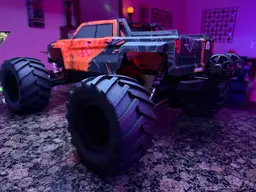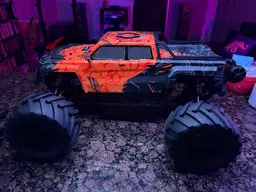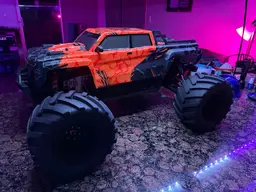
New Savage Flux XL v2 - it's wrenchin' time!

This site may earn a commission from merchant affiliate
links, including eBay, Amazon, and others.
What ChatGPT says might be correct, although it doesn't seem to apply in this case. I don't know the manufacturing process behind those forged gears from HPI, but in my experience the forged diffs are far behind in terms of durability when compared to the machined ones.
This is a picture showing two forged input gears, on the left, one with two months of use, on the right a new one, it's easy to see how much wear the teeth have on the used one.
View attachment 12416
Wish I'd taken photos of one forged input gear I took out of the front diff some years ago; the teeth were all gone...
Just to be clear, this happened while using the original 2200kv motor. Now I'm using the machined diffs with a much stronger 1650 kV motor, and after two years the gears look like new...
Also, the machined gears are way more expensive than the forged ones, so it doesn't make sense to pay more for less durability.
Ait I see, great to have real-life experiences, ait I will be upgrading to those machined ones than ty ty!
How much are needed 2 right?
 
You sure?
I asked chatgpt and got this:

Forged steel is generally stronger than machined steel when we're comparing structural strength and toughness.
Here’s why:

1. Forged Steel:


  • Process: Forging involves deforming the steel under high pressure, often while hot.

  • Grain Structure: This process aligns and compresses the metal's grain structure, which enhances its strength, fatigue resistance, and impact toughness.

  • Strength: Forged parts are typically stronger and more resistant to shear and tensile forces than machined parts made from the same base material.

  • Applications: Used in high-stress applications like crankshafts, aircraft parts, and heavy machinery.

2. Machined Steel:


  • Process: Machining involves cutting away material from a steel billet or forged blank.

  • Grain Structure: The original grain structure is retained or possibly interrupted by cutting; there's no improvement in strength from the machining process itself.

  • Strength: The strength depends entirely on the base material. Machining is for precision, not enhancement of strength.

Summary:​

PropertyForged SteelMachined Steel
Grain alignmentYes (improves)No
StrengthHigherLower (generally)
Fatigue resistanceHigherLower
PrecisionLower (as-forged)Higher (CNC, etc.)

Conclusion:​


If maximum strength and durability are your priority (e.g. in load-bearing or impact-prone parts), forged steel is stronger. If you need high precision or intricate shapes, machined steel might be the better option—often machining is done after forging to combine both benefits.

from my own research forged is indeed stronger.

View attachment 12415
Yes I come across this as well but alot of people are saying machine is the strongest
 
You sure?
I asked chatgpt and got this:

Forged steel is generally stronger than machined steel when we're comparing structural strength and toughness.
Here’s why:

1. Forged Steel:


  • Process: Forging involves deforming the steel under high pressure, often while hot.

  • Grain Structure: This process aligns and compresses the metal's grain structure, which enhances its strength, fatigue resistance, and impact toughness.

  • Strength: Forged parts are typically stronger and more resistant to shear and tensile forces than machined parts made from the same base material.

  • Applications: Used in high-stress applications like crankshafts, aircraft parts, and heavy machinery.

2. Machined Steel:


  • Process: Machining involves cutting away material from a steel billet or forged blank.

  • Grain Structure: The original grain structure is retained or possibly interrupted by cutting; there's no improvement in strength from the machining process itself.

  • Strength: The strength depends entirely on the base material. Machining is for precision, not enhancement of strength.

Summary:​

PropertyForged SteelMachined Steel
Grain alignmentYes (improves)No
StrengthHigherLower (generally)
Fatigue resistanceHigherLower
PrecisionLower (as-forged)Higher (CNC, etc.)

Conclusion:​


If maximum strength and durability are your priority (e.g. in load-bearing or impact-prone parts), forged steel is stronger. If you need high precision or intricate shapes, machined steel might be the better option—often machining is done after forging to combine both benefits.

from my own research forged is indeed stronger.

View attachment 12415
This chat GPT entry wasn't specific to gears though, and that matters. Context is everything.

Machined gears offer superior precision and strength, while sintered gears are more cost-effective for high-volume production due to less material waste and a faster process.
 
New shoes for the xl … and finally getting back to working on this one.

IMG_0407.webpIMG_0405.webpIMG_0404.webp

(little worried about the wheels... we will see but these tires are great)
 
Last edited:
one part I can't find is the longer link for the XL which goes between the servo arm and the bellcrank ... it's longer than the one for the X and has a step down in the middle... I guess I an just measure it and find something that length in alum...

View attachment 12349
My center steering link just broke. Did you ever figure out an alternative replacement?
 
hey hey.... well that's a bummer. Yeah that part def looks like the weakest link in an otherwise very beefy steering setup on my truck. I have not found something that's a direct alum replacement for that... I have one spare from HPI #160311 .. with that you get the whole under skid plate assembly and the link.. I reckon that's the plastic bits that are unique to the XL flavor of the truck.

The part is just a hair over 50mm eyelet to eyelet ... I was going to just rig something with a 50mm alum link or turnbuckle that looks beefy.. connect it to the top on one side and the bottom on the other end.. I think that'll be ok.. I got super side tracked with my Arrma Notorious and Typhon all year so haven't been driving or working on the Savage.. but I have all the stuff to build the bullet proof diffs and install them.. so am planning on that soon.. I'll look into that steering link again then.
 
Last edited:
hey hey.... well that's a bummer. Yeah that part def looks like the weakest link in an otherwise very beefy steering setup on my truck. I have not found something that's a direct alum replacement for that... I have one spare from HPI #160311 .. with that you get the whole under skid plate assembly and the link.. I reckon that's the plastic bits that are unique to the XL flavor of the truck.

The part is just a hair over 50mm eyelet to eyelet ... I was going to just rig something with a 50mm alum link or turnbuckle that looks beefy.. connect it to the top on one side and the bottom on the other end.. I think that'll be ok.. I got super side tracked with my Arrma Notorious and Typhon all year so haven't been driving or working on the Savage.. but I have all the stuff to build the bullet proof diffs and install them.. so am planning on that soon.. I'll look into that steering link again then.
Thanks, your response definitely helps; however, ironically I can’t order this part directly from the United States lol! I can’t believe such an oversight was made as so many parts are compatible from model to model. The HPI website indicates this part hasn’t been discontinued, so hoping I can find an “authorized vendor” to order it directly or get lucky on eBay or the other sites. Much appreciated.
 
I still intend to pull the savage xl apart and replace that link with something alloy and some good turnbuckle ends or something... attach top one side and bottom other side... it should work ok. around 50mm or so..
 
I think I will end up with a 50mm metal link with threaded ends

https://www.amazon.com/RCHUBAM-Stainless-Steering-75mm-155mm-Compatible/dp/B0CRYDKPKK?th=1

and some nice heavy duty DU-BRO ends for it..

https://www.amazon.com/Que-T-10pcs-Metal-Crawler-Titanium/dp/B0828V58GN

that will work for sure. some blue loc-tite.

because this will be angled it will need to be more like 57mm ish or so.. the 50mm link + ends should work.

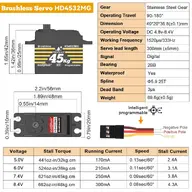
edit: also make sure the bellcrank spring is set properly as with no plastic in the chain it'll be harder on the servo... my servo is pretty beefy though.

$55 on amazon rn https://www.amazon.com/gp/product/B0F2N69462

71ZxccV4KyL._SL1500_.webp
 
Last edited:
I think I will end up with a 50mm metal link with threaded ends

https://www.amazon.com/RCHUBAM-Stainless-Steering-75mm-155mm-Compatible/dp/B0CRYDKPKK?th=1

and some nice heavy duty DU-BRO ends for it..

https://www.amazon.com/Que-T-10pcs-Metal-Crawler-Titanium/dp/B0828V58GN

that will work for sure. some blue loc-tite.

because this will be angled it will need to be more like 57mm ish or so.. the 50mm link + ends should work.

edit: also make sure the bellcrank spring is set properly as with no plastic in the chain it'll be harder on the servo... my servo is pretty beefy though.

$55 on amazon rn https://www.amazon.com/gp/product/B0F2N69462

View attachment 12698
Show pictures of it when finished please! I don’t know if I have the servo spring adjusted correct or not. I tightened it down pretty hard against the plastic nut when it broke that linkage arm.
 
I got the parts for the steering link and will be working on that soon.. I am rebuilding all my diffs now with bullet proof machined 29t/9t gears... wow that stock blue grease is a lot of fun to clean up lol.

This video just dropped explaining the diffs in detail.. very cool and timely!

 
Thanks!! Yeah the draco stuff does look good. I had a life upheaval in March and haven't had bandwidth for the RC stuff but I am slowly getting back into it now... I need to put that steering link (for the XL) together and install it.. and swap my diffs in.
 

Latest posts

Members online

Back
Top