Any update?
If the engine is impossible to turn, there is good likelyhood that the sleeve has not been inserted correctly in the crankcase. And after one has tried to turn the crank in such cases with a power drill, it is nearly guaranteed that the liner and possibly even the crank case are damaged beyond repair...
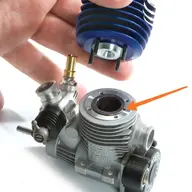
To prevent this I always recommend that before even trying to start a new engine, one should always open the cooling head and the back plate to remove any leftover manufacturing debris, ensure the conrod is not placed backwards, that the liner is correctly aligned with the block and that the gaskets between the burn room and cooling head are all there or have not been forgotten altogether. Also important is to make sure the carburateur o-rings have not been forgotten during assembly and that carb sits tightly inside the block.
Once the engine is checked thoroughly, and after you have checked for possible air leaks, and primed it, you can proceed to getting it started. I recommend using a heat gun. But 40C will not help much. You will need to go higher. Just make sure you apply the heat gradually and evenly to the cooling head, and all sides of the crank case to avoid thermal shock. Also take care you don't apply the heat gun directly at plastic parts such as the back plate and the carb. Once the engine is warm enough, loosen the glow plug by 1/2 or even 1 turn. You should now be able to turn the crankshaft using the pull starter with relative ease and get it running with a few pulls. I also recommend the use of Prolux Easy Glow Ignitor. This ignitor delivers a little more voltage, between 1.5v to 1.7v but pushes through 3 amperes in current. This amount of current provides the ideal glow for nito combustion...
Note that all engines manufactured at the Golden Lion Enterprise Ltd in Taichung, i.e. HPI, Kyosho, Axial, Force, LRP, Gaupner, Alpha, SH, etc. have a significantly tighter pinch than the engines manufactured in Italy such as Novarossi, GRP, or Picco. This all has to do with reliance on more economical tools and machinery as well as the use of inferior casts, lower quality alloys, cheaper chroming, coating, hardening and other similar procedures in Golden Lion.
But in my experience, abnormally high pinch is more often than not a sign of misalignment of the notch at the top of the sleeve and the little pin on the block.